An interview on racism at Annoor Academy.
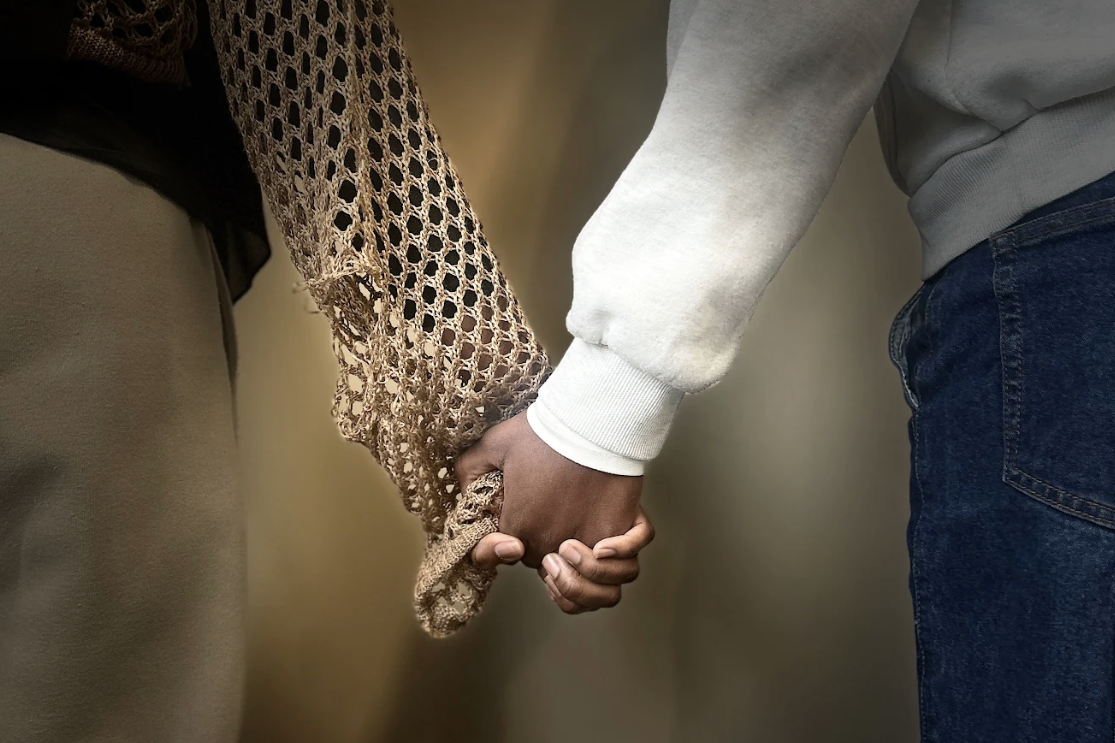
Two girls holding hands in solidarity (Sumaya Blevins/The Ambassador)
“I think it’s ridiculous that we have other Muslims being racist to other Muslims. It really will never click in my head. It doesn’t make sense at all.” This was said by Aicha Bamba, one of my 9th-grade peers at Annoor Academy, and one of the few black students at this school. In light of recent racist remarks and actions made by the student body, Maryam Elatar and I decided to interview our classmates, cousins Aicha and Zakiya Komara. While the interview started in a lighthearted manner, as the questions got more serious, so did the tone in the room. As we progressed, it became clear how important these issues were to both Zakiya and Aicha. The hope is that after reading this article, you will also feel the impact that words have on people.
We started the interview by asking where both the girls’ families originated. “We’re all from Liberia, Guinea, and the Ivory Coast,” Aicha said. “In West Africa,” Zakiya finished for her. As cousins, Aicha and Zakiya have a very close relationship that is evident in their connection during conversations.
After formalities, we jumped right into the discussion of racism at the school, with Maryam asking what the meaning of the n slur is, and what harm it can bring. Zakiya answered. “This word is deeply rooted in black history,” she says. “When people from the West African continent were taken without any consent or will. And they were treated, mistreated horribly, like they were animals. Like they weren’t even human. They were dehumanised.” Dehumanization, the act of depriving someone of human qualities, personality, or dignity, is the perfect word to describe not only the meaning of the racial slur, but also the general effect of slavery and racism. Zakiya continues. “So this word is just-”
Aicha breaks in. “Absurd!”
“It’s horrible.” Zakiya continues.
“It’s horrible to be used in a school where there’s so much diversity.” This is from Aicha, her face showing exactly the indignation she, and so many other Black Americans, have been forced to feel.
“You talked about the diversity in the school,” I start once both girls finish talking. “Do you think that, because there is a majority Arab population here, that could have some effect?”
“I think for like the most part, yes,” Aicha answers. “ But I feel like if there were more black people [in the school], they would just let them [say the n-word].” The issue of complacency among people of color in the school is not a new one, but it is definitely a serious problem that can stem from many things, mainly peer pressure or wanting to fit in with other students.
“Honestly,” Zakiya says, “I think the reason we can find that word to be used in society so much is that it’s so normalized now. And the thing, specifically for this school, is that there’s such a minority of Black students here, and so people feel comfortable sitting around with people who are the same as them, since they’re not going to correct them if they’re all doing it.”
“You guys mentioned how it [racism] is normalized in our school. What do you think could be a way for students to eliminate the word from the school’s vocabulary by punishing students within the student body?” Maryam asks.
“I don’t think it’s possible.” Aicha and Zakiya both respond. “No one is clearly standing up for what is right,” Zakiya elaborates. “So they’re not going to advise each other. And sometimes maybe people do talk about it, like ‘oh my gosh, she’s doing this, he’s doing this.’ [They know] it’s not right. But you don’t see people standing up for it or trying to change it since it’s been going on for so long.”
“So you think the only way to make a change would be if students come together to try and stop students, if they try and correct their friends, that’s the only way there would be a solution?” I confirm.
“I don’t think that’s the only way,” Zakiya says. “That’s an option. But I think most of this was done from home. If you’re not getting corrected and educated about this at home, you’re going to think it’s okay to go out and do it in public. So I think it’s more of what they’re raised to be doing. And just like, like, no education from where they are, and they don’t understand it [racism]. That’s it.”
“Aside from the students, how do you think the administration, the principal, how do you think they should punish a student who does this? And there’s like proof that they do it, or someone says they did it. Do you think suspension? Detention? Expulsion?” I ask.
“I don’t think suspension will really do anything,” Aicha answers. “Because, I mean, the suspension is to make students think about what they did at home, but if, like previously said, they’re literally just staying at home, there’s nothing else you can do.”
“I think if something is going to be effective and permanent, then expelling them because that would go on their record and would really affect them.” Zakiya adds. “Since if they’re not getting taught about how racism’s bad at home, then nothing’s going to be fixed.”
“Moving on to the next topic,” I say, “Do you think, because this is an Islamic School, racism is especially a problem? Since we’re supposed to be specifically against racism?”
“I think it’s ridiculous that we have other Muslims being racist to other Muslims,” Aicha answers. “It really will never click in my head. It doesn’t make sense at all. I think they [racist people] should be stopped, and they should be truly educated.”
“Finally,” Maryam says, “Do you have anything else you would like to add about the whole situation happening at our school?”
“Yeah, I do,” Zakiya responds. “This is just horrible, honestly. It’s ridiculous. It’s really hurtful. It really hurts that people are bashing something that I’m so proud of being. And they just have no respect for my culture. Just being a black person, you feel like everybody’s looking down on you. You don’t feel supported because no one is standing up for you. But at the end of the day, how I feel is that if I don’t get justice from this, Allah will honestly give me justice. And one thing I always believe in is that what goes around comes around. Because if you don’t stop, it’s going to come back to you anyway.”
“I think being black itself is honestly already hard,” Aicha adds. “But being black and Muslim is definitely a struggle. So with those two together, you have to just remember Allah made you Muslim for a reason. He loves you. That’s just like another sign of your love from Allah. And even if I don’t get justice from the situation, I get it from Allah, and that just hurts them. Like, imagine being asked on the day of judgment about a word. Literally a word.”
With that, the interview concludes, and Aicha and Zakiya go on to their normal school lives. Doing homework, attending after-school clubs, and hanging out with friends, all while ignoring the undercurrent of judgment and hate. But we shouldn’t be able to ignore the blatant racism at this school anymore. As Muslims, we need to know that we are all brothers and sisters, that although the n-word may be just a word to you, to students like Aicha Bamba and Zakiya Komara, it affects their whole world.
Note 1 – This interview was conducted as a response to the n-slur having been written on the wall of the boys’ bathroom, in addition to accumulated uses of the word at this school for some time. At the time of the interview being conducted, the culprits were being searched for, and now, months later, when this article will go out, the perpetrator has been found and punished with in-school-suspension for a day and cleaning the bathroom. We can only hope this will be enough. Don’t be racist; it’s not funny or edgy, it’s just hurtful and haram.
Note 2 – Direct statements from the students have been changed slightly for comprehension, but the message has not been changed at all.